
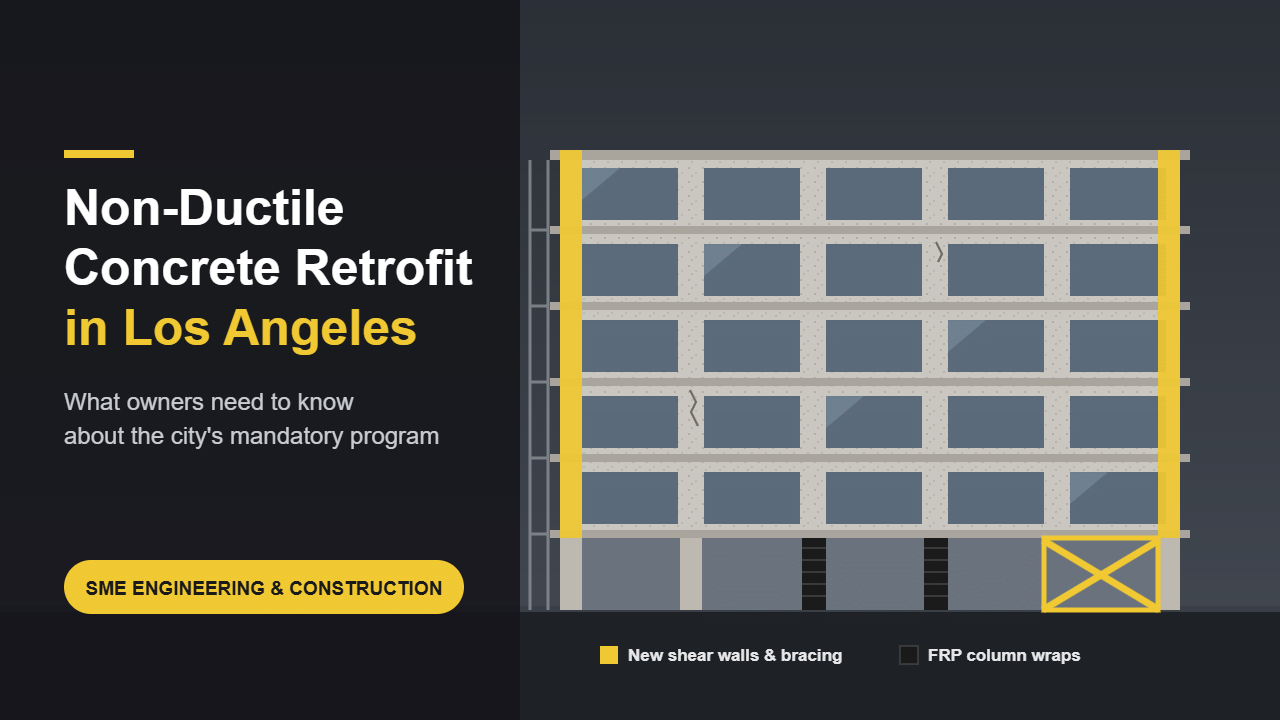
If you own an older concrete building in Los Angeles, a non-ductile concrete retrofit may not be optional. Under the city’s mandatory retrofit program, owners who receive an Order to Comply from the Los Angeles Department of Building and Safety (LADBS) must evaluate their building and, if needed, strengthen it on a set schedule.
The deadlines are long, but the work is complex. Engineering, permits, tenant coordination and construction all take time, and owners who start early have more choices and fewer surprises.
This guide explains what non-ductile concrete is, which buildings the ordinance covers, the compliance timeline, common retrofit methods, and seven proven steps to a successful non-ductile concrete retrofit.
What Is a Non-Ductile Concrete Building?
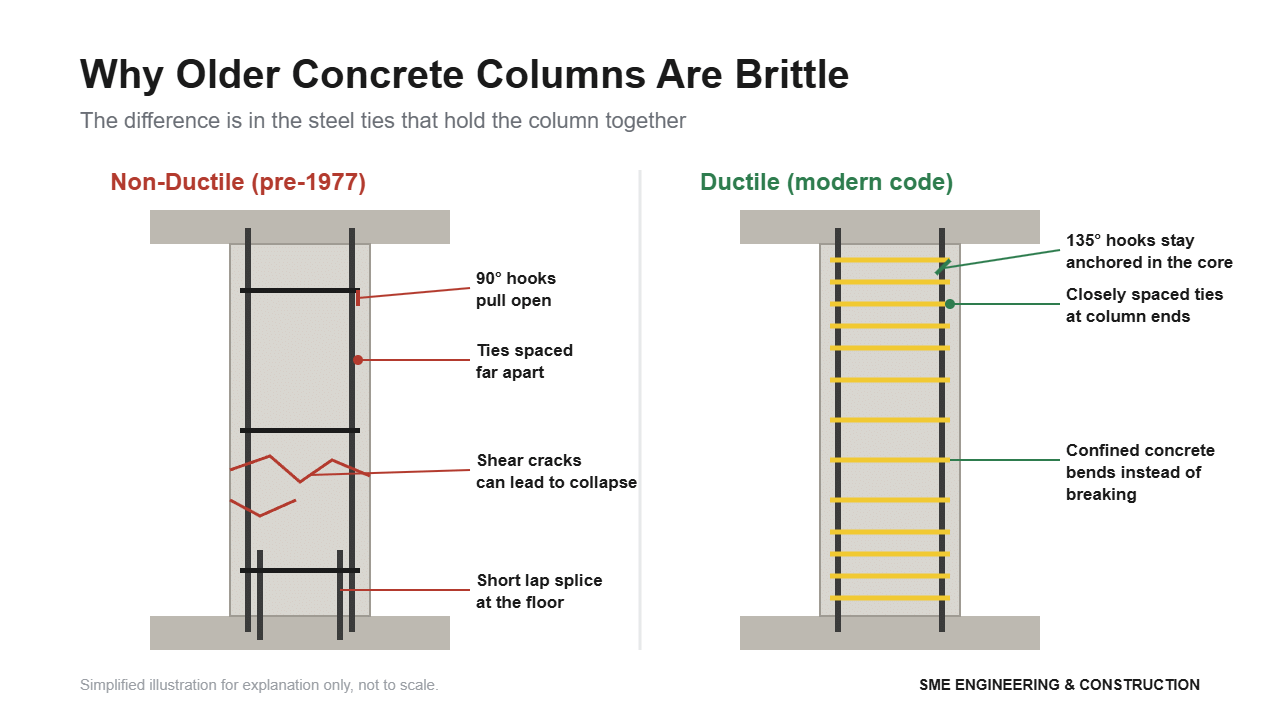
A ductile building bends and absorbs energy in an earthquake. A non-ductile building is brittle: its concrete columns and joints can crack and fail suddenly, with little warning.
The difference is mostly in the reinforcing steel. Older codes allowed ties spaced far apart, hooks that pull open under load, and short lap splices at floor levels. Modern codes require closely spaced ties with hooks anchored in the concrete core, which keeps the column together when it is shaken hard.
Los Angeles adopted its program after studying failures of older concrete buildings in earthquakes such as Northridge, Mexico City and Christchurch. A non-ductile concrete retrofit addresses these weaknesses before the next major quake.
Does the Ordinance Apply to Your Building?
Los Angeles Ordinance 183893 took effect on November 22, 2015. According to the LADBS Property Owner’s Guide, a building is covered when both of these are true.
- Concrete Construction
The building has concrete floors or roofs supported by concrete walls, columns or frames.
Masonry infill walls do not change this.
- Older Permit
The permit application for the new building was submitted before January 13, 1977.
Detached single-family homes and duplexes are excluded.
If you believe your building was listed by mistake, you can appeal within 60 days of the Order to Comply. Evidence can include a permit showing plans were submitted on or after January 13, 1977, proof of an earlier compliant retrofit, or plans showing the building is not concrete.
The Compliance Timeline
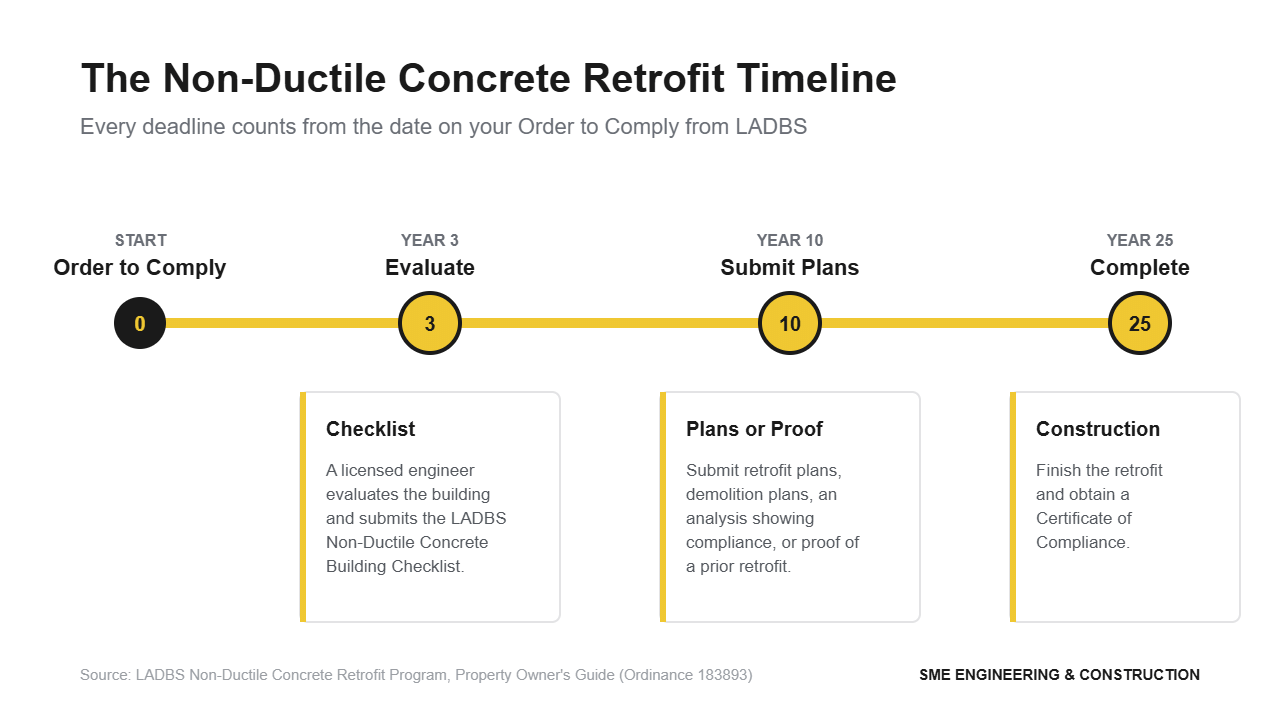
Every non-ductile concrete retrofit deadline counts from the date on your Order to Comply.
- Within 3 Years: Evaluate
Hire a California-licensed engineer to evaluate the building and submit the LADBS Non-Ductile Concrete Building Checklist with supporting documents.
- Within 10 Years: Submit Plans or Proof
Submit retrofit plans, demolition plans, a structural analysis showing the building already complies, or proof of a prior retrofit.
- Within 25 Years: Complete Construction
Finish the work and obtain a Certificate of Compliance from LADBS.
Residential owners must also notify tenants in writing before the retrofit permit is issued, following Los Angeles Housing Department rules. PACE financing can help spread retrofit costs over time through property tax assessments.
Common Retrofit Methods
No two buildings get the same non-ductile concrete retrofit. The engineering analysis shows where the building is weak, and the design targets those spots.
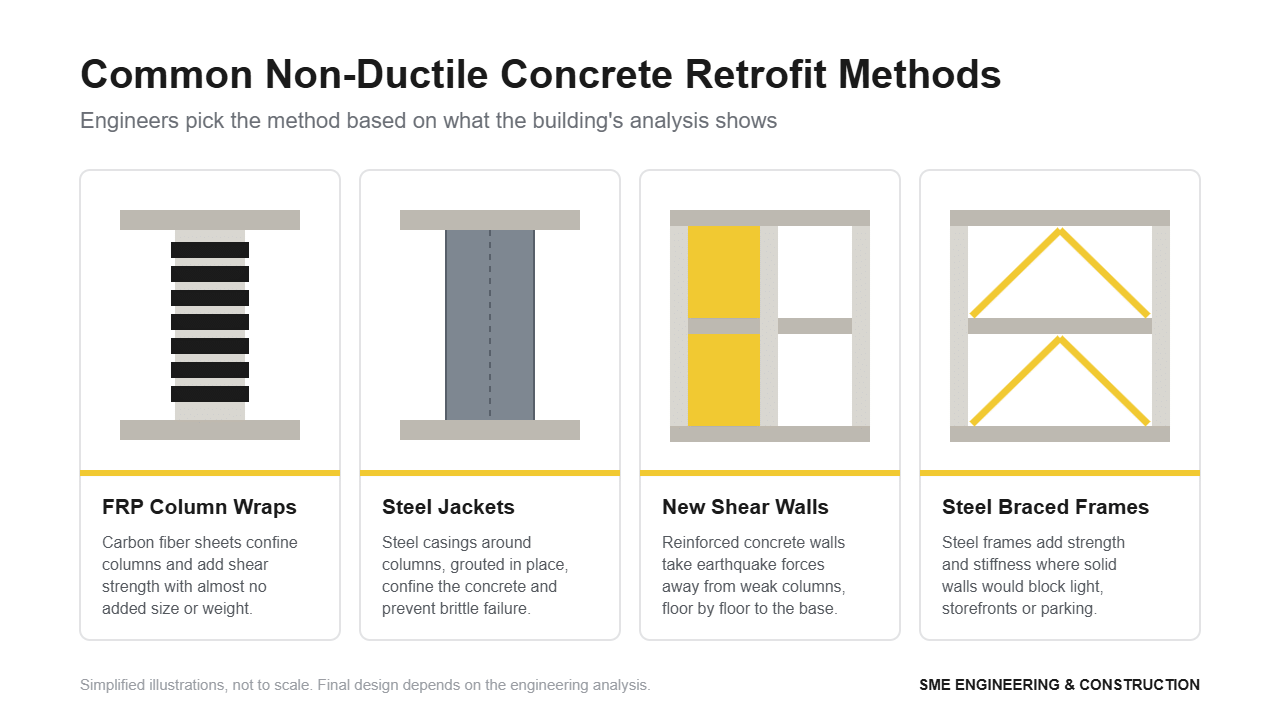
- FRP Column Wraps
Carbon fiber sheets confine columns and add shear strength with almost no added size or weight.
Learn more about FRP strengthening.
- Steel Jackets
Grouted steel casings around columns confine the concrete.
They prevent the sudden, brittle failures older columns are prone to.
- New Shear Walls
Reinforced concrete walls take earthquake forces away from weak columns.
The walls carry those forces floor by floor down to the foundation.
- Steel Braced Frames
Steel frames add strength and stiffness to the structure.
They work well where solid walls would block light, storefronts or parking.
Many projects combine methods and include concrete repair of spalled or corroded elements found during the work.
Why It Pays to Start Early
Twenty-five years sounds like plenty of time, but early action has real advantages. Engineering and plan check take longer than most owners expect, and qualified engineers and contractors get busier as deadlines approach.
Starting early also lets you coordinate the non-ductile concrete retrofit with other planned work, such as a commercial tenant improvement or an adaptive reuse conversion, so walls and ceilings are opened only once. SME has completed seismic retrofit and structural strengthening work under the city’s non-ductile concrete ordinance, including on historic buildings.
7 Proven Steps to a Successful Non-Ductile Concrete Retrofit
A smooth project depends on knowing the building before committing to a design. These are the steps we follow.
- Step 1: Review Your Order to Comply
Note the date on the order, since every deadline counts from it, and check whether an appeal makes sense.
- Step 2: Gather Existing Drawings
Original plans, permits and past repair records save time and reduce testing.
- Step 3: Investigate and Test
Engineers inspect the structure and use non-destructive testing, cores and rebar scanning to confirm what is really there.
- Step 4: Analyze and Submit the Checklist
A licensed engineer completes the LADBS checklist and the structural analysis.
- Step 5: Design the Retrofit
The structural engineering design targets the building’s weak points with the least disruption to tenants and operations.
- Step 6: Permit and Plan for Tenants
Submit plans to LADBS, notify tenants and plan the work around occupied spaces.
- Step 7: Build, Inspect and Close Out
Construct the retrofit, pass city inspections and obtain the Certificate of Compliance.
Frequently Asked Questions
- How much does a non-ductile concrete retrofit cost?
It varies widely with building size, height and condition. The engineering evaluation is the first step to a reliable budget.
- Can I stay open during the work?
Often, yes. Retrofits are commonly phased so tenants and businesses keep operating.
- What if my building was already retrofitted?
You can submit proof of a prior retrofit that meets the city’s standards instead of new plans.
- Who can do the evaluation?
The checklist must be completed by a California-licensed engineer.
Conclusion
A non-ductile concrete retrofit protects your tenants, your building and your investment. Knowing your deadlines, starting the engineering early and working with one accountable team are the best ways to keep the project on budget and on schedule.
SME Engineering & Construction provides seismic retrofitting, structural engineering and construction across Los Angeles. Call (323) 284-2960 or request a quote to talk through your building.